
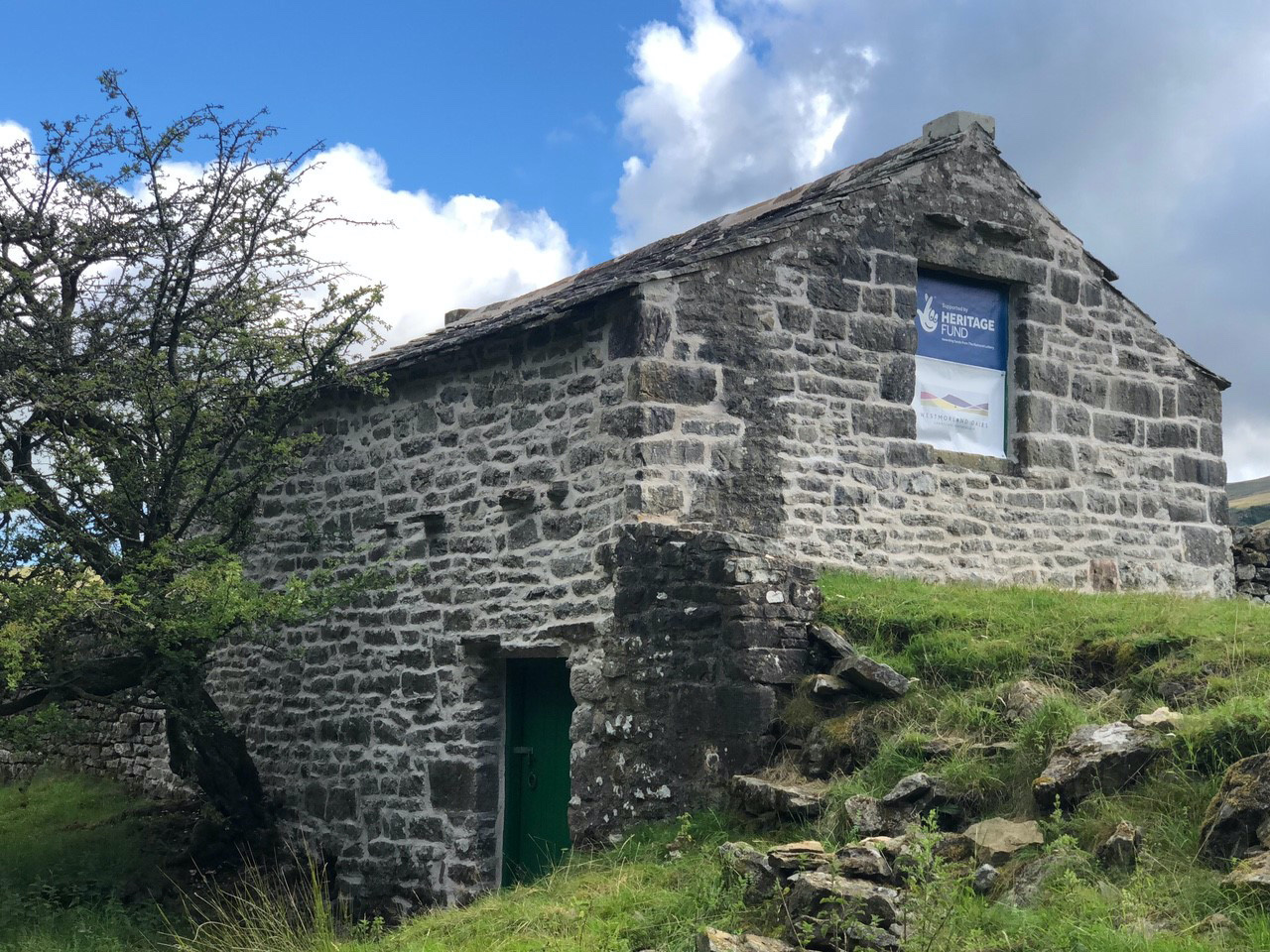
Traditional farm buildings are a distinctive feature of the Westmorland Dales landscape but they are also one of the most vulnerable types of historic building in the area. With dramatic changes in farming practices over the last 50 years, many farm buildings are now redundant and have therefore been demolished, left to decay or converted to other uses.
Now, thanks to a grant scheme, some of the area’s most characteristic buildings will see in many more years and delight generations to come.
Financial support is being provided via the Westmorland Dales Landscape Partnership Scheme through its ‘Traditional Farm Building Grant Scheme’.
The grants are helping to fund restoration work to save some of the region’s most important cultural assets, raise their profile and reveal their heritage importance in the Westmorland Dales.
The grant scheme has been funded by the National Lottery Heritage Fund and Yorkshire Dales Millennium Trust. It is also supported by the Building Conservation Officers of the Yorkshire Dales National Park Authority.
Roger Stott, Community Grants Officer, Yorkshire Dales Millennium Trust said: ”Preserving our natural and built heritage is important if we are to connect people to the past of this special area. We’re delighted to be able to help support these vital schemes and look forward to seeing these cultural places preserved for future generations.”
Work has recently been completed on a field barn at Pendragon Castle, owned by the Pendragon Estates. This is a small field barn, which would have contained a byre (cattle housing) and a mew (hay storage).
It is an interesting barn, partly due to the fact that it is on the castle site, and as such contains some quite historic built heritage, including well-cut stone that would have come from the castle itself (following its abandonment after the death of Lady Anne Clifford), and the rear wall that predates the rest of the barn structure and relates to a series of earthworks on the site.
Hannah Kingsbury, Cultural Heritage Officer, Westmorland Dales Landscape Partnership Scheme said: “One of the special aspects of this project is not only restoring the buildings to survive another couple of hundreds of years, but also increasing everyone’s enjoyment and understanding of these buildings”.
As part of the works at Pendragon, blocked in square ventilation holes were revealed. Ventilation holes are useful indicators to the layout of a building. As for instance, they will be found where the hay is stored, but not where the cattle is housed.
Works were required to the walls – pinning gaps and the addition of mortar – as well as to the roof – the replacement of a damaged roof timber, and the replacement of cracked ridge tiles.
John Bucknall, owner: “Essential repairs were becoming necessary. And I have been delighted with the work. In particular the high quality of the work to the walls of this humble building. Not only is the lime pointing beautiful in itself but the stonework is transformed and sings the story of its history”.
Work is now underway on a second barn situated along the coast-to-coast route near Orton, in need of structural repair.
