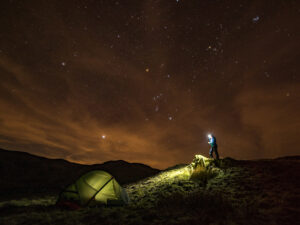
People are being asked to take part in an annual Star Count to record how clear our view is of the night sky. CPRE, the countryside charity, is working with the British Astronomical Association’s Commission for Dark Skies to map light pollution levels across the country.
In the biggest citizen science project of its kind, people are being asked to count the number of stars they see in the Orion constellation to help map the best and worst places in the UK to enjoy a star-filled night sky. The results will be compared with 2021’s findings, gathered during lockdown, which revealed a notable drop in the number of people experiencing severe light pollution given urban areas were much quieter and fewer large buildings were in use.
A clear view of a star-filled night sky has a hugely beneficial effect on our mental health and, like access to other forms of nature, helps reduce stress and increase a sense of peace and wellbeing. Research has even shown that regularly spending time looking at the stars can lower blood pressure and reduce depression. Yet, the night sky, which is a hugely significant part of our natural environment, has no legal protection.
Tom Fyans, deputy chief executive of CPRE, the countryside charity, said: “The night sky is one half of our experience of nature; but we don’t often think of it like that. In and of itself, it helps balance our mental health and boost our emotional wellbeing. Recollect that experience of a starry sky and you instinctively know it soothed you.
“But our view of the night sky – and all the benefits it undoubtedly brings – is being blotted out by light pollution. Like all forms of pollution, it is damaging our mental and physical health, and also having a severe impact on wildlife. Yet, it is a form of pollution that is allowed to increase year on year without any effort being made to control the damage it is causing.”
In 2021, over 7,000 people took part in CPRE’s Star Count. The proportion of people reporting ‘severe light pollution’, defined as ten stars or fewer being visible to the naked eye in the Orion constellation, had declined from 61% to 51%. The proportion of ‘truly dark skies’, defined as over 30 stars being visible within the Orion constellation, had increased from 3% to 5%. This was likely due to the count taking place during lockdown, with reduced levels of artificial light leading to a clearer view of the night sky.
Now people are being urged to once again come together for one of the nation’s biggest citizen science projects to help discover if light pollution has increased since the end of lockdown – and where the best views of the stars can be found.
Emma Marrington, dark skies campaigner from CPRE, the countryside charity, said: “Light pollution means many people only experience a limited view of the night sky, and it also disrupts wildlife’s natural patterns. By showing where views are most affected by light pollution, the evidence can be used to help protect and enhance the nation’s dark skies, improving our health, wellbeing, wildlife and the environment.”
Bob Mizon, of the British Astronomical Association’s Commission for Dark Skies, said: “The night sky is a great antidote to the stresses of modern life; you go out, look up and suddenly everything is calm. The stars made every atom in our bodies; they are our chemical parents. They’re intimately connected to us and even in these light polluted days people have a real desire to see the stars.
“Just as we have an affinity with trees and the rest of nature, we have a connection to the night sky. It is literally 50 per cent of our environment – from east to west – and it is the only part of our environment that has no protection in law. People are very rapidly coming to the conclusion that what we do to the environment has a direct impact on our wellbeing. The same as coral reefs dying off and rivers clogged with plastic bags – one more aspect of our impact on the environment is our pollution of the night sky and yet it is completely unprotected.”
Lockdown impacts light pollution in Cumbria
Comparing the Star Count results for Cumbria in 2019 with 2021 (2020 was a weather wash out, so only 18 unrepresentative recordings), Friends of the Lake District, the Cumbria branch of CPRE, discovered that the impact of lockdown from Covid had a dramatic effect on light pollution in Cumbria last year, with four times as many people seeing 30 stars or more in 2021 than in 2019:
2019 2021 % Change
10 stars or less 51.9% 32% Almost -20% (-10% nationally)
30 stars or more 1.9% 8.1% +6.2% (+5% nationally)
No. of readings 54 269
Friends of the Lake District say they hope as many people as possible take part this year, so that we can see how life post lockdown has affected light pollution.