Brampton is celebrating the completion of a natural flood management scheme which will help keep the town’s homes safe and dry.
The project, which was led by the community in partnership with a local farmer, has installed earth barriers and begun the restoration of a natural bog known as the moss.
And it is already proving its worth. Data from the recent Storm Boelo showed the reworked ground held back half a million litres of water an hour, holding it back for up to eight hours before it made its way into the beck that flows into the town.
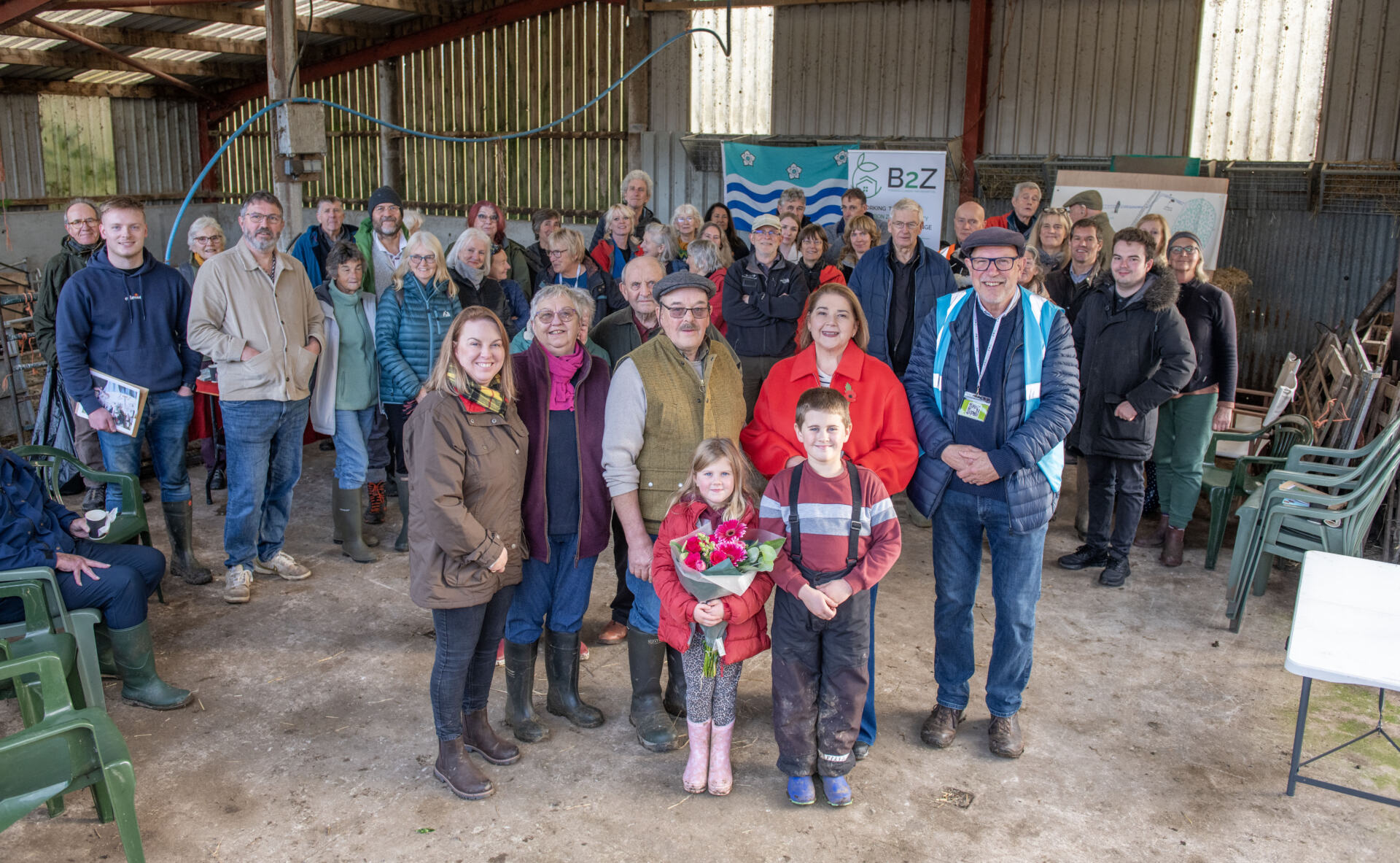
More than 40 people gathered at Brampton Fell Farm last Friday, 30 October, to celebrate, including some who had previously had their homes flooded near the town’s police station.
Brampton faces an increased flood risk from the beck which flows under the town centre, because of climate change, with 116 properties expected to be hit in a 100-year event, rising to 154 by 2050 and 196 by 2080.
Carlisle MP Julie Minns and representatives from Eden Rivers Trust, Cumbria Wildlife Trust, Natural England and the Environment Agency joined locals for a presentation and visit to the site.
Ms Minns said she would be bringing the scheme to the attention of Parliament.
“I am so pleased to see this come to fruition,” she said. “It is hugely important for this community. We have so much to be thankful for in this area but there is an ever-present fear of the flood risk.
“You have done an amazing thing for the community. A scheme that is working with nature to protect communities is wonderful and I will certainly raise it in Parliament.”
The scheme was led by local not-for-profit Brampton 2 Zero Community Interest Company spearheaded by Brampton resident and retired schoolteacher Phil Furneaux, in partnership with farmer Alan Bowman.
It began in 2021 and was project-managed by Eden Rivers Trust with advice from Natural England and funded by the Environment Agency with a grant of £250,000 which was all invested in local contracts.
Phil admitted: “I did have a few sleepless nights – I am just a physics teacher, and this is a £250k project!
“But we succeeded and got it done on budget and got it on time. This project is all about restoring nature and building resilience to climate change.”
He thanked farmer Alan Bowman, saying: “This will stop flooding in Brampton. It is a gift to Brampton and the community recognise that.”
Alan, who has farmed the area for 33 years, was a little emotional when he told the gathering how his childhood home near Kirkoswald was flooded in 1963, and then again a few years later, after everything had been restored.
“We have recreated the moss so the water stops there and it is going back to nature,” he said.
A bund or low-level earth barrier has been created at Brampton Beck near the railway station to regulate the amount of water flowing in during high rainfall, with smaller bunds created at nearby Brampton Fell Moss along with shallow ponds which will fill with natural bog plants such as sphagnum moss, and leaky dams which also help to hold back water allowing it to disperse slowly.
Alan said the performance of the changes can be accessed on a phone and data from recent Storm Boelo showed it can hold back water back for eight hours and hold back half a million litres an hour.
He hopes the moss can be a place where people come to relax and that it can be good for mental health.
“It could be a place for groups to come for talks and walks but also a place to come and appreciate nature and let nature heal.
“Who is going to do this sort of thing if farmers don’t?” he said.
The outrun from the original stream will be measured using equipment from Lancaster University with the data shared with scientists across the country.
John Rattray, Head of Conservation Operations at Eden Rivers Trust, said nature was recovering at the site.
“This area is now doing the job it is meant to do,” he said. “We have blocked ditches and the moss has been building up, and we have peat in there.
“We’ve seen more nesting birds including lapwing and curlew. The sphagnum moss can hold 10 times its weight in water. We have been very lucky to have a landowner like Alan to give the land over.”
Emma Austin, Land Management and Conservation Advisor from Natural England, said: “The reversal of land drainage to allow the restoration of the wetland habitats offers us an amazing opportunity for citizen science and all kinds of projects.”
In the longer term it is hoped to add a bird hide, boardwalk and dipping platform as well as seating which will make the moss accessible for visitors, and for educational visits from schools.